
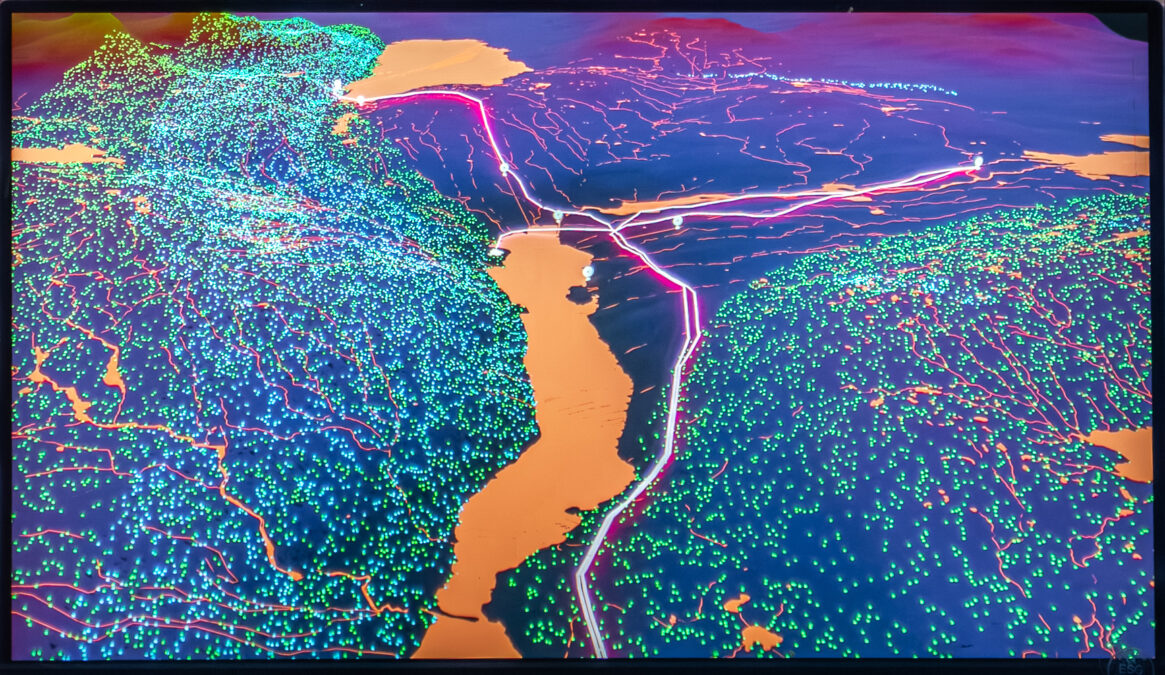
Earth and Internet (want to be free) Symposium – Interdisciplinary artistic research and the platform landscape
12 November
18.00–20.00
Venue: Smedjan
Language: English
The presentation part of the symposium is free and open for all.
Book your spot here november 9 at the latest.
How can we imagine more just, sustainable and non-extractive digital futures? And how are interdisciplinary artistic research practices pointing to alternative ways to think about critical resources and infrastructures?
On November 12, VISTRANS* will bring together artists, researchers, and scholars in a symposium dedicated to exploring digital extractivism, environmental and data justice, and emerging forms of resistance to the planetary impacts of digital technologies. In collaboration with Färgfabriken, the symposium is inspired by themes of extractivism and colonialism in Färgfabriken’s current exhibition “Rare Earth, Rare Justice” by Nigerian artist Ndidi Dike, and investigates the potential of artistic research to tackle urgent questions which deserve critical attention.The acceleration of technology and geographies of digital media infrastructures cannot be separated from the geopolitics of supply chaings, including the burdens of mining of critical and conflict minerals on fragile territories and vulnerable communities, and the environmental costs of facilities such as data centers. Importantly, these processes often unfold at the margins of democratic processes and public participation, and are experienced at various scales, from local to planetary, profoundly unequally.
During the workshop, scholars and artists focus on the developments both in the so-called Global North and Global South violently divided by extractivism and coloniality, yet also connected through practices of resistance, repair, re-existence, and liberation. What are the urgent and critical debates challenging this moment and offering alternatives, and how can interdisciplinary research advance these critical agendas?
The keynote program is open for the public and features: Gianfranco Selgas, researcher in political ecology and co-director of the Political Ecology Research Theme at KTH, who will present his recent research about the visuality of extractivism around fossil fuels in Venezuela; and the Denmark-based artistic research group ARNEN (Artistic Research Network on Extractivism in the North) will present their work on extractive frontiers between polluted remains in the Arctic and ruins in Gaza.
The keynote presentations will be held at Färgfabriken from 6 to 8 pm. The event is free, but registration is required until November 9th.
Bios:
Gianfranco Selgas De Silvi is a researcher in political ecology and co-director of the Political Ecology Research Theme @ KTH, affiliated with the Division of Strategic Sustainability Studies (KTH SEED), and his research is currently supported by Formas (Swedish Research Council for Sustainable Development). Prior to joining KTH in 2026, he was a British Academy Postdoctoral Fellow at University College London (UCL), where I conducted research and taught at the Centre for Multidisciplinary and Intercultural Inquiry (CMII), between 2022-2025.
Artistic Research Network on Extractivism in the North (ARNEN) is both an informal network and a working group of artists and researchers with a shared interest in questioning contemporary extractivist paradigms in the geographical North. As a working group, ARNEN conducted a joint research trip to Sulitjelma in Norway (2024), which led to the exhibition Extractive Frontiers at Titled, Copenhagen (2025). As a network, ARNEN organised the symposium Extractivism in the North (University of Copenhagen, 2025). ARNEN’s founding members are artists Honey Biba Beckerlee and Nanna Elvin Hansen, and architectural researcher Runa Johannessen.
Programme
13.00–13.20
Intro + round of introductions
13.20–13.45
Guided tour Rare Earth, Rare Justice
14.00–15.30
Panel talk
15.30–16.00
“Fika” paus
16.00–17.30
Panel talk
18.00–20.00
Presentations. Free admission, open for all.
About VISITRANS
VISTRANS is a research group supported by DigiTrans at Södertörn University, co-led by visual artist and researcher Isabel Löfgren, visual artist and Senior Lecturer in Media and Communication Studies, and mirko nikolić, environmental artist and post-doc in Aesthetics. The Studio creates spaces for artistic research about the confluence of art, technology, and ecology seen from multiple geographic and epistemological interdisciplinary perspectives. The event is kindly supported by DigiTrans research platform, Södertörn University, in collaboration with Färgfabriken.
Contact
The event is kindly supported by
DigiTrans research platform, Södertörn University