
Mattias Bäcklin Fantomen
Solo exhibition, Project Rooms
Opening February 28
11.00–16.00
Opening and Artist talk with Björn Norberg and Mattias Bäcklin

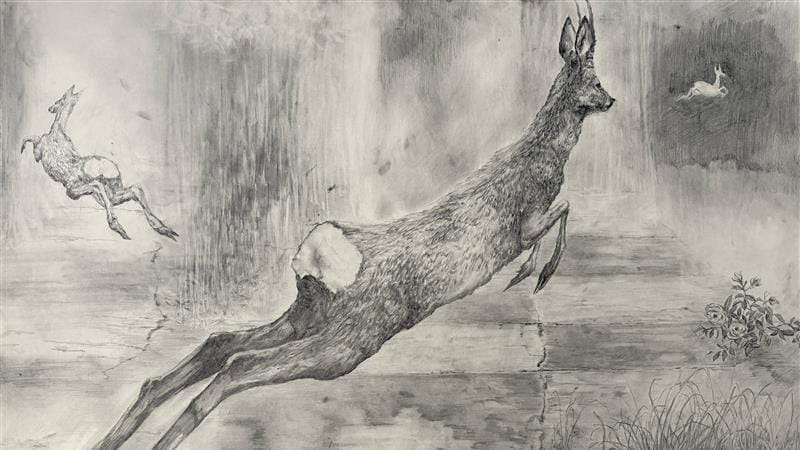
In his exhibition at Färgfabriken, Mattias Bäcklin presents sculptures and drawings that take their point of departure in nature and in the processes that shape life, material, and landscapes over time. The works often engage with questions of ecological balance, change, and decay, and with how the world is in constant motion – processes that are difficult for us as humans to perceive in everyday life. Here, nature does not appear as a motif in the traditional sense, but as something active and ongoing, marked by decomposition, growth, and a continuous transition between life and death.
Bäcklin’s practice reveals a clear interest in connections and consequences: how small events can set larger processes in motion, and how materials transform over time. Many of his works revolve around phenomena that usually take place in the background or remain hidden, such as biological chains, slow shifts, and traces of past events. Through sculpture and drawing, he gives form to these processes without explaining them outright, instead allowing materials, surfaces, and narratives to speak on their own terms.
About the artist

Mattias Bäcklin was born in 1969 in Uppsala and is currently based in Stockholm and Enköping. He studied at the Royal Institute of Art in Stockholm (special student 2004–2005; printmaking project 2011–2013; glass project 2013–2014) and at Konstfack, Going Public (2016–2017). His artistic practice has evolved through a combination of experiences. His background as an ornithologist and insect collector has given him a close relationship to nature studies, observation, and fieldwork, while his past within urban subculture and breakdance has influenced his thinking around movement, the body, and resistance. In the encounter between these worlds, a personal visual language emerges, where fragments of nature and human-made structures are shaped into new contexts. The result is a body of work that moves between the documentary and the narrative, where memory, mythology, and personal observation become open – often understated, yet charged – experiences.
Image above: Korsdrag o spridda skurar, 2026. Photo: Mattias Bäcklin